Reading & library01
Let a PDF speak on your iPhone
A document in Files can become your next listening session. Start with a useful page rather than generating an entire book before you have heard a sample.
3 min read
 FolioTone.
NOTES ON BOOKS, VOICES & EVERYDAY LIFE
Practical guides and small rituals for the books you want to read. Made for curious minds, free hands and the occasional quiet moment.
Discover FolioTone for iPhone & iPad01 / THE ESSENTIAL GUIDE
A document in Files can become your next listening session. Start with a useful page rather than generating an entire book before you have heard a sample.
Read the story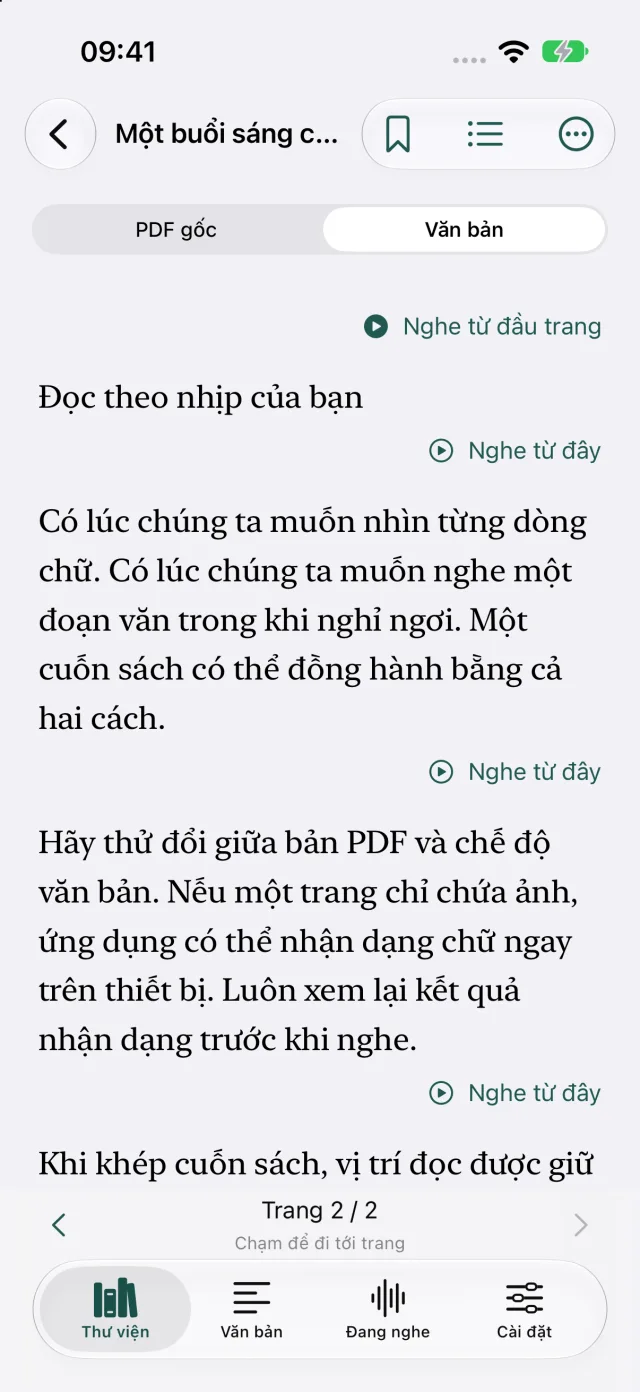 Your pages. A new voice.
Written by the FolioTone team. Real workflows for iPhone and iPad: PDF & TXT, Vietnamese & English, with speech generated on your device.
THE COLLECTION
40 stories in your selection
A document in Files can become your next listening session. Start with a useful page rather than generating an entire book before you have heard a sample.
A wide screen keeps the page in view; audio lets you look away. A library stored on your device makes those two ways of reading work together.
A scan can look excellent while containing no usable text. OCR creates the bridge; your review helps the spoken version preserve what the page actually says.
Plain text avoids complex page layouts, but its line breaks still shape the listening experience. A small cleanup before generation can make a document easier to follow.
Pages describe how a document is presented. Audio parts describe how its words are prepared for listening. The two can coexist without matching one for one.
Switching from reading to listening does not have to mean starting over. A deliberate starting point helps you keep the thread of a page you have already begun.
A book does not end at the bottom of a page. Continuous listening keeps the narrative moving when the following pages contain suitable text to read aloud.
The screen can rest while a finished recording plays. Creating that recording needs its own period with the app open and active before the listening session.
A dependable listening session often begins the evening before departure. Preparing the right document matters more than carrying an entire library you have never opened.
A useful library does not have to be large. It should help you open the right book, identify finished audio, and avoid getting lost among almost identical copies.
Your eyes know to finish the left column before moving right. Extracted PDF text does not always preserve that journey across an editorial page.
A document password and readable source text are separate questions. Opening the page is the first step; a useful listening copy also needs the right words inside.
A running chapter title helps orient you on paper. Repeating it aloud after every page can interrupt an otherwise comfortable listening session.
Not every page needs narration, and not every passage needs your eyes the whole time. Giving each reading mode a purpose makes a study session feel less scattered.
A page of notes can become something to listen to on a walk. Start with a short passage and check the reading before preparing the whole document.
A suitable English voice can make a document easier to follow. Clear English is built for listening copies you prepare directly on your own device.
A study document may change languages halfway down the page. Meaningful sections and matching voices make the listening version much easier to review.
Before trying a different voice, look at the punctuation. A listening draft often needs clearer sentence boundaries than a page of hurried notes.
A short sequence such as 03/04 can carry more than one meaning. A deliberate proofreading pass keeps that ambiguity out of your listening copy.
A long listening copy does not need to be treated as one indivisible job. Smaller parts make progress visible and revisions easier to locate.
There is no single best format for every listening copy. First decide whether the recording will be played, shared, or edited in another tool.
Exporting is only half the job. The other half is knowing where the recording went, which revision it contains, and whether it opens outside the app.
An interrupted task does not automatically require regenerating the entire document. First establish which parts actually need another preparation attempt.
Creating audio and playing audio are different jobs. Give on-device preparation its own place in your schedule before relying on a lengthy listening copy.
A broken sentence and an interrupted recording can sound similar at first. Checking each layer separately makes the problem easier to describe and investigate.
Notes on a screen use layout to explain relationships. A listening version needs complete sentences, useful transitions, and an order that makes sense without the page.
Do not choose a voice from a greeting alone. A short sample taken from your document tells you more about the listening copy you are about to prepare.
Not every morning has room for a full chapter. A modest passage can give a book a place in your day without turning reading into another deadline.
A commute can hold a small reading session. The useful work often happens beforehand, while you can review the document and prepare audio without distractions.
A familiar passage is a comfortable starting point for combining text and speech. Choose material thoughtfully, and treat synthetic audio as one resource among several.
You do not have to wait for a listening exercise on the right subject. Start with a note, an introduction, or a page of English material you already need to read.
A familiar sentence can feel unexpectedly long when read aloud. A listening pass adds another perspective before you send a draft, without replacing careful editing.
Notes written for your eyes do not always work well for your ears. A little restructuring makes it clearer what each listening part is meant to cover.
Generating speech without uploading a document matters. Its original storage location and the destination of an exported copy are separate parts of the same privacy picture.
A listening library can hold several versions of the same content. Knowing what each copy is for makes storage cleanup more deliberate and less frustrating.
The useful choice starts with your reading habits. Look at the voice you actually use and the limits you encounter, rather than the longest feature list.
If you bought Pro but its entitlements are missing, start with the purchase and Apple account. Books, audio, and purchase rights are separate parts of the picture.
The most useful tour is completing one small task yourself. Go from a short passage to playable audio before exploring every setting and option in the app.
Both bring words to your ears, but they are made differently. Knowing the distinction helps align your expectations with the document and listening experience you want.
Do not wait until a device change to look for the original book. Clear names and a few verified copies make it easier to understand what you can bring with you.
FROM THE JOURNAL TO YOUR LIBRARY
Read PDFs and turn your words into Vietnamese or English audio. Start with the free voices on iPhone and iPad.
Get FolioTone on the App Store